
Sponsoring chess at your school, as a teacher or a parent volunteer, doesn’t require any chess knowledge. Teams have won the state championship with sponsors who didn’t even know how to play! You just need to provide:
- time for the kids to play together, and
- at least one kid who knows how to play and is willing to teach the others.
Getting started
- Join our mailing list using the form below. This is the most important step: it’s how we announce every tournament and tell coaches everything they need to know during the season.
- Check the scholastic tournament calendar for upcoming events.
- Keep these handy:
- Flier for the 2026–27 KY Chess scholastic season for students, parents and coaches
- Rules: there’s no need to read the rulebook; see What rules govern scholastic chess in Kentucky? below
- Our Parent’s Guide to Scholastic Chess Tournaments, which is worth sharing with your families
Questions? Email our scholastic director at [email protected]. We’re happy to help new coaches get started.
Where can my students learn chess?
For learning the game, see our New to Chess page and our learning resources. KY Chess also runs an official club on ChessKid with regular online tournaments, and our students and parents page explains what to expect at a first tournament. US Chess publishes a Guide to Scholastic Chess; it is from 2021 and predates most online play, but its advice on running a school club still holds.
How do I register my team?
There is no team registration for the season. For each tournament, register your students individually and give their school (team) when you register them. Players from the same school are then scored together as a team.
Do my students need US Chess memberships?
Most, but not all, tournaments require players to be members of US Chess. Each tournament’s announcement says whether it does. Students can join US Chess online.
Can a school have a team if it does not provide a coach or formally sponsor a club?
Yes! Several teams have been organized by the students themselves. All you need is (a) a group of students from the same school who show up to tournaments together and (b) an adult who is willing to be their point of contact with the tournament organizers. The adult (parent or teacher) does not need to know anything about chess.
What if my students can’t afford to play?
Please contact [email protected]. We will make sure that any students who want to play in KY Chess tournaments are able to do so.
US Chess also has a program that provides free boards and memberships to a limited number of Title I schools each year. Applications go through the KCA: contact the scholastic director at [email protected] to apply.
How can my players be recognized during the season?
Every US Chess-rated tournament your students play in Kentucky counts toward the Kentucky Scholastic Circuit, which ranks players and schools based on both their performance and their engagement with Kentucky chess. Each March, the top players are named to the All-Kentucky Teams, and every player who reaches a set score earns All-Kentucky Honorable Mention or a place on the KY Chess Honor Roll.
The four KY Chess championships count double (the State Grade Championships, your Quad, the State Individual Championships and the State Team Championship), so encouraging students to play in them is the best way to help them earn honors. See the Students and Parents page for details.
If a player’s school or grade is missing or wrong on the Circuit page, email [email protected] with “KY Scholastic Circuit” in the subject line.
What rules govern scholastic chess in Kentucky?
The short answer for beginner coaches: you don’t need to read any rulebook to get started. For KY Chess tournaments, everything you need to know before each tournament comes through the mailing list, and you can always ask the scholastic director any questions.
For reference, the detailed rules for KCA scholastic competitions are in the Blue Book (the 2025-26 edition; the 2026-27 edition will be posted soon).
Team competition
How are team scores calculated?
Most team tournaments add up the scores of the top individual players from each school, usually the top four. Check each tournament’s announcement for its exact rules.
The one exception is the State Team Championship in March, where the best player from your team plays the best from the other team, your second best plays their second best, and so on.
How does a team qualify for the State Team Championship?
For scholastic chess, Kentucky is divided into four regions called Quads (A, B, C and D); the counties in each are listed below. Each winter, every Quad holds a Regional Championship, often just called “the Quad”. It is both the individual championship for that region and the only way for a team to qualify for the State Team Championship, the final event of the scholastic season in March. The top four teams in each section (K-1, K-3, K-5, K-8 and K-12) at each Quad qualify for the State Team Championship.
Which region (“Quad”) is my school in?
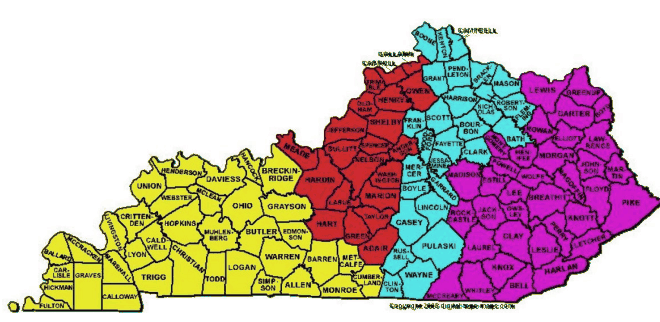
| Quad | Counties |
|---|---|
| A West | Allen, Ballard, Barren, Breckinridge, Butler, Caldwell, Calloway, Carlisle, Christian, Crittenden, Cumberland, Daviess, Edmonson, Fulton, Graves, Grayson, Hancock, Henderson, Hickman, Hopkins, Livingston, Logan, Lyon, Marshall, McCracken, McLean, Metcalfe, Monroe, Muhlenberg, Ohio, Simpson, Todd, Trigg, Union, Warren, Webster |
| B Louisville area | Adair, Anderson, Bullitt, Carroll, Gallatin, Green, Hardin, Hart, Henry, Jefferson, Larue, Marion, Meade, Nelson, Oldham, Owen, Shelby, Spencer, Taylor, Trimble, Washington |
| C Central and Northern | Bath, Boone, Bourbon, Boyle, Bracken, Campbell, Casey, Clark, Clinton, Fayette, Fleming, Franklin, Garrard, Grant, Harrison, Jessamine, Kenton, Lincoln, Mason, McCreary, Mercer, Nicholas, Pendleton, Pulaski, Robertson, Russell, Scott, Wayne, Woodford |
| D East | Bell, Boyd, Breathitt, Carter, Clay, Elliott, Estill, Floyd, Greenup, Harlan, Jackson, Johnson, Knott, Knox, Laurel, Lawrence, Lee, Leslie, Letcher, Lewis, Madison, Magoffin, Martin, Menifee, Montgomery, Morgan, Owsley, Perry, Pike, Powell, Rockcastle, Rowan, Whitley, Wolfe |